
Noticing a flat spot on your baby’s head can raise a lot of questions. Is it normal? Will it improve? And if your pediatrician mentions a helmet, what will it involve, and what will it cost?
Those are fair questions. Head-shape changes in the first months of life are common, and most are positional. That means they come from pressure on a baby’s soft, fast-growing skull, not from anything a parent did wrong. Many babies are managed with simple steps like repositioning. For some, a clinician may recommend a cranial remolding helmet when it is clinically appropriate. That is often when parents start searching for the baby helmet for flat head cost, and whether insurance may help.
The honest answer is that there is no single price that fits every family. This guide explains what shapes the cost, how insurance coverage typically works, which extra costs to ask about, and how to find a provider near you. It is general information, not medical advice for your baby.
Quick answer: The cost of a baby helmet for a flat head varies by baby, provider, and insurance plan, so no one number applies to everyone. The most accurate figure comes from an individualized estimate after a clinical evaluation and an insurance benefits check.
What Is a Cranial Remolding Helmet?
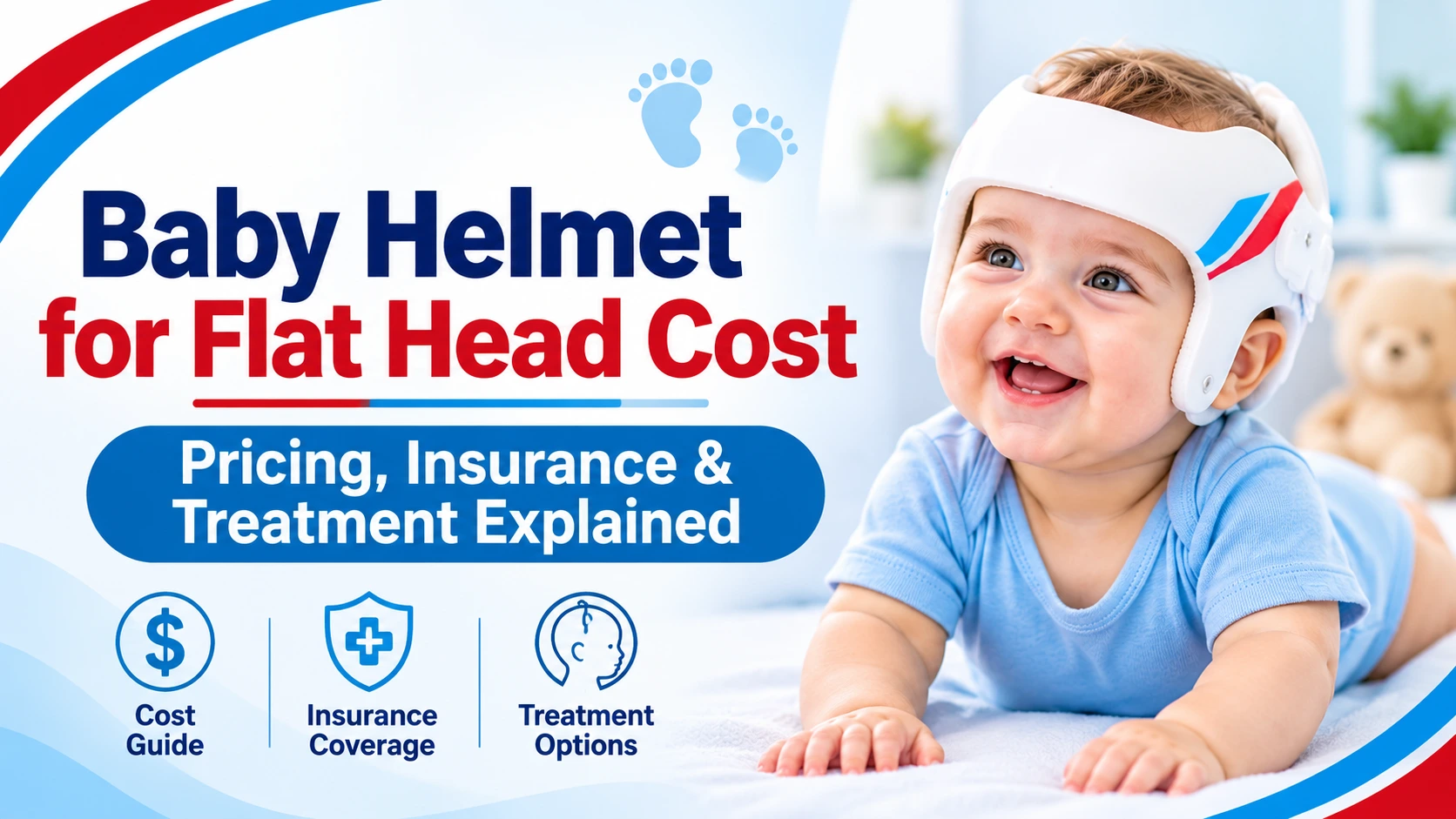
A cranial remolding helmet, also called a cranial remolding orthosis, is a lightweight, custom-made medical device. It is designed to guide a baby’s skull growth toward a more balanced shape. It is not a safety helmet. It is made for one child, based on that child’s measurements. You can read more about custom baby cranial helmets on the GOAL Pediatrics service page.
Helmets are most often used for positional head-shape changes, such as:
- Plagiocephaly: a flat spot on one side or the back of the head. From above, the head may look uneven.
- Brachycephaly: the back of the head is flat, so the head looks wide and short from front to back.
- Scaphocephaly: the head looks long and narrow from front to back. This shape can have different causes, so evaluation matters.
It also helps to know that positional head shape is different from craniosynostosis, a condition in which the skull’s growth seams close too early. The American Academy of Pediatrics describes positional skull deformities as generally benign and reversible, and notes that clinicians need to tell them apart from craniosynostosis. That is one reason a professional evaluation comes first.
Baby Helmet for Flat Head Cost: Why There Is No One Price
If you have searched for the cost of a baby helmet for a flat head, you have probably seen very different numbers. That is because the total depends on your baby’s needs, the treatment plan, and how your insurance applies. A figure from a website or forum may not reflect any of those.
It also helps to separate two numbers:
- The total cost of care: what the provider charges for the full treatment plan.
- Your out-of-pocket cost: what you may owe after insurance, based on your deductible, copay, or coinsurance.
Instead of relying on a general price, ask the provider for an individualized estimate after your baby is evaluated. Asking for it in writing can make it easier to compare and plan.
What Factors Affect the Cost of a Baby Cranial Helmet?
Several things can influence the baby helmet cost for a flat head. Not every factor applies to every family, but these are the ones worth asking about:
- Your baby’s head shape and condition. The type and degree of asymmetry can affect the recommended plan and how long treatment may last.
- Type and customization of the helmet. Cranial helmets are custom-made from measurements of your baby’s head, so the process involves more than picking a size off a shelf.
- The provider and treatment plan. Plans differ in what they include, such as the evaluation, fitting, and follow-up care.
- Follow-up visits and adjustments. Babies grow quickly, so helmets are typically monitored and adjusted over time.
- Location and insurance arrangements. Whether a provider is in your plan’s network, and your plan’s deductible and coinsurance, can change what you owe.
Does Insurance Cover the Cost of a Baby Helmet for a Flat Head?
Sometimes, but it depends. Coverage is decided by your specific plan, its medical necessity requirements, and the insurer’s own policies. Those policies vary a lot. Some health plans and state Medicaid programs set criteria under which a helmet for a positional head shape may be considered medically necessary. Others do not cover it for that purpose, or treat it as cosmetic. Nobody can guarantee coverage in advance, so it is worth checking before you begin.
Common things insurers ask for include:
- A referral or prescription from your pediatrician or another clinician.
- Clinical documentation, such as the evaluation, head measurements, and notes on what has been tried so far (for example, repositioning).
- Prior authorization, which some plans require before the helmet is made and others do not.
What to ask your insurer
- Does my plan cover cranial remolding helmets for positional plagiocephaly or brachycephaly?
- Do I need a referral, prescription, or prior authorization?
- Is the provider in my network?
- How much of my deductible has been met, and what are my copay or coinsurance amounts?
- What is the appeals process if a request is denied?
Your provider’s team can often help verify benefits and gather paperwork. It is still a good idea to confirm directly with your insurer and write down the date, the representative’s name, and what you were told.
Are There Additional Costs Associated With Baby Helmet Therapy?
The helmet is one part of the picture. Depending on the provider, parents may want to ask about:
- The initial evaluation of your baby’s head shape.
- Scanning or measurements used to design a custom helmet.
- Helmet fitting appointments.
- Follow-up visits to check progress and skin.
- Adjustments or replacement, if your baby’s growth or the fit calls for it.
Not every provider charges for these separately. Some include several of them in one treatment plan. The key is to ask what is included, what is billed separately, and what you can expect to pay for each.
Is a Baby Helmet Worth the Cost for Flat Head Treatment?
This is a personal decision, and it should be made with your pediatrician and a qualified helmet provider, not from a price alone.
The purpose of cranial remolding therapy is to guide skull growth toward a more balanced shape. But not every baby with a flat spot needs a helmet. Guidance from the American Academy of Pediatrics describes repositioning, tummy time while awake, and exercises as the usual approach for mild to moderate cases, with helmets considered mainly for more severe cases or when a baby is not improving. Always keep placing your baby on their back to sleep, and talk with your pediatrician before changing anything about sleep.
It is also fair to know that research on helmets is mixed. One randomized controlled trial published in the BMJ found no meaningful benefit compared with no helmet. Other, non-randomized studies have reported faster improvement with helmets, and a Congress of Neurological Surgeons guideline supports helmet therapy in some moderate to severe cases while rating the certainty of that evidence as limited. No one can promise a specific cosmetic or medical result, and every baby responds differently.
A clinical evaluation helps you weigh the severity of your baby’s head shape, what has already been tried, and what you hope to achieve, so you can decide whether the cost makes sense for your family.
When Should Parents Consider a Baby Helmet for a Flat Head?
Timing can matter because a baby’s skull grows quickly in the early months, and a clinician’s options may change as your baby grows. Whether a helmet is suitable depends on your baby’s age, head shape, and clinical assessment, so there is no one-size-fits-all age.
It may be a good time to ask your pediatrician if:
- A flat spot is not improving despite repositioning and tummy time.
- Your baby’s head looks noticeably uneven from above.
- You are unsure whether what you are seeing is a typical positional shape.
- Your baby’s head shape looks different in other ways, such as a ridge or unusual shape from early on. Other conditions are managed differently, and a professional should check.
Earlier evaluation gives you more time to ask questions, try other approaches, and make a calm decision. It does not mean something is wrong, and there is no need to panic.
Baby Helmet for Flat Head Cost Near Me: How to Find the Right Provider
If you are searching for baby helmet for flat head cost near me, you are really looking for two things: a qualified provider and a clear estimate. A few tips:
- Start with your pediatrician. They can evaluate your baby and may refer you to a provider your insurer recognizes.
- Look for pediatric experience. Ask about the clinician’s training and experience fitting helmets on infants.
- Call and ask about cost before booking. A good team will explain what an estimate depends on and what they need to verify your insurance.
- Ask about the full process, including appointments and follow-up care, not just the helmet.
GOAL Pediatrics serves families across Utah, Arizona, Texas, and Idaho. You can view clinic addresses and contact details on the GOAL Pediatrics locations page and ask the team which clinic is the best fit for your family.
Questions Parents Should Ask Before Starting Baby Helmet Therapy
Bring this list to your first appointment:
- What is the total estimated cost, and what would I owe after insurance?
- Can you verify my insurance benefits, and is a referral or prior authorization needed?
- What is included in the treatment plan: evaluation, scan or measurements, fitting, follow-ups, adjustments?
- If the helmet needs to be adjusted or replaced as my baby grows, is that included or billed separately?
- How many visits should I expect, and how often?
- How long is treatment expected to last, and how will progress be measured?
- How do I care for and clean the helmet, and what wear schedule do you recommend?
- Who do I contact if I notice skin irritation, a poor fit, or signs my baby is uncomfortable?
- Are there payment options or financial assistance if the out-of-pocket cost is a concern?
How GOAL Pediatrics Supports Families Through Cranial Helmet Care
This section describes GOAL Pediatrics’ own services, based on information on its website.
GOAL Pediatrics creates custom baby cranial helmets for flat head and head shape concerns, including plagiocephaly, brachycephaly, scaphocephaly, and other cranial asymmetry. Care follows a clear “game plan”:
- Meet your coach. A comprehensive head shape evaluation.
- Personalized assessment. Measurements and treatment planning.
- Custom helmet fitting. A helmet designed specifically for your baby.
- Regular progress checks. Monitoring your baby’s growth and making adjustments.
The team also teaches families how to check their baby’s skin and when to call. Your clinician will share the expected timeline and wear schedule at your Game Plan Session.
When it comes to cost, GOAL’s team can walk you through your options and help you understand what to ask your insurance provider. Coverage varies by plan. To prepare, the New Patient page suggests bringing your insurance card, any referral from your healthcare provider, and previous records. It also offers a hardship form for requesting financial assistance.
Ready to talk through your baby’s options? You can schedule a Game Plan Session or make an appointment with the GOAL team.
Frequently Asked Questions
How much does a baby helmet for a flat head cost?
The cost depends on your baby’s needs, the provider’s treatment plan, and your insurance. Because of that, no single price is accurate for everyone. The best way to find out is to request an individualized estimate from a qualified provider after an evaluation.
Does insurance cover a baby helmet for a flat head?
It may, depending on your plan and its medical necessity requirements. Some plans require a referral, documentation, or prior authorization, and some do not cover helmets for positional head shape at all. Confirm with both your insurer and your provider before starting.
What is included in the cost of a baby cranial helmet?
This varies by provider. Some treatment plans include the evaluation, measurements, fitting, and follow-up adjustments, while others bill certain items separately. Ask for a clear breakdown of what is and is not included.
Does my baby need a helmet for a flat head?
Not necessarily. Many babies with mild flat spots are managed with repositioning, tummy time, and exercises. A pediatrician or qualified provider should evaluate your baby’s head shape to say whether a helmet is appropriate.
Will a flat head go away without a helmet?
Some mild flat spots improve with repositioning and as babies become more mobile, but results vary. A clinician can assess your baby’s head shape and tell you whether monitoring, other steps, or a helmet makes sense.
Does a baby cranial helmet hurt?
A properly fitted helmet should not hurt. Babies usually need a short time to get used to wearing one. Your provider should teach you how to check your baby’s skin and when to call if something seems wrong.
How long does a baby wear a cranial helmet?
The length of treatment depends on your baby’s age, head shape, and rate of growth. Your clinician will review progress at regular visits and give you a timeline and wear schedule based on your baby’s needs.
Conclusion
The baby helmet for flat head cost is different for every family. It depends on your baby’s head shape, the treatment plan, the provider, and what your insurance plan covers. That is why a general price from the internet is rarely the right number for your situation.
The most helpful next step is an individualized evaluation and a clear cost discussion. Ask what is included, have your benefits verified, and bring your questions. Not every baby with a flat spot needs a helmet, and a qualified clinician can help you decide what is right for yours.
If you would like to talk it through, the GOAL Pediatrics team is here to help. Contact GOAL Pediatrics to schedule a Game Plan Session.